Topic: PoliticsReanimating the Nonhuman: Black Feminist Ecologies

How should we relate to the natural world? As something we have power over, that has power over us, or something else altogether? Drawing on Black Ecofeminist traditions of thought, Francesca Rechere explores the history of mainstream Western ‘materialist’ understandings of nature, tracing their colonial underpinnings. She asks whether we might reconceptualise our power relations with the non-human natural world, reanimating, enriching and reconnecting in the process. Illustration by Tanya Wilson. See this article in the flesh and many others in Issue 12: Power, out now!

By Francesca Rechere
Each time I walk through woods, fields or grasslands, I am reminded of my reverence for the natural world – of the sacred beauty and magic in nature’s complex everyday processes. It is this sense of awe that can invite us to slow down and to reflect. I am reminded of humility, reciprocity and respect, and a will to better practice and embody them. As a Black woman forager, my practice is guided by a desire to reclaim ancestral knowledge, to rewrite our historical barriers to nature, and by the foragers rules: take only what you need, never overconsume and always ensure there is enough left to share with the other beings native to that ecosystem. For me, these are political acts. They uproot the assumption that land, plants and animals exists solely for human extraction.

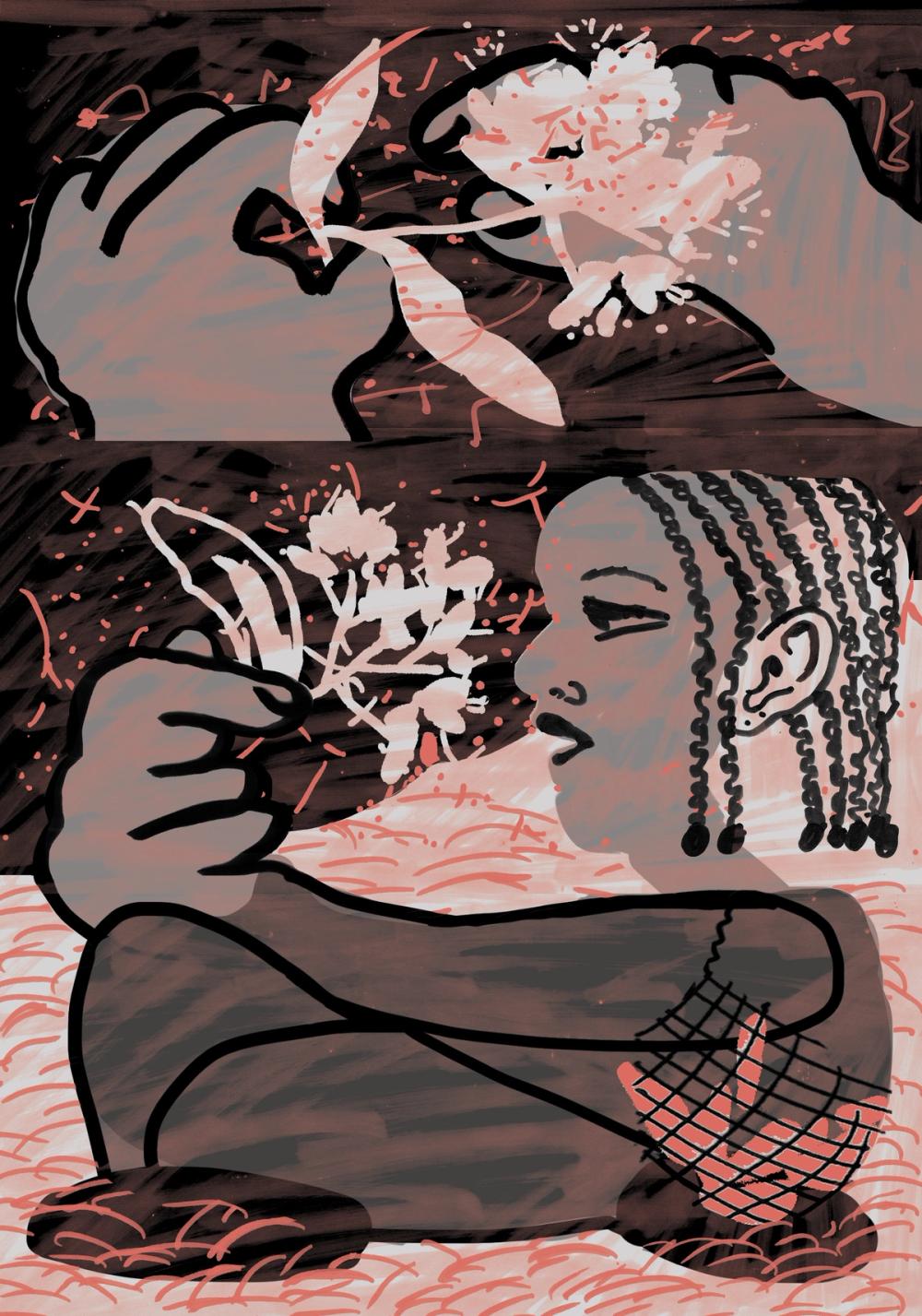
An illustration of a black woman touching a flower and raising it to to her mouth as though to speak to it
Illustration by Tanya Wilson for this article in IFLA! Issue 12: Power. Tanya illustrated all of the articles in our 'People Power' sub-theme. Pick up a copy of the new issue to see more!

As I weave between trees, I look at the world we are part of through this particular lens – one that not only enriches life, but simultaneously urges me to question where our modern society has gone so wrong, and what might be done to put things right. Rooted in the experiences of Black women across the African diaspora, Black feminist ecological thought interrogates how global capitalist modernity has not only reconfigured economies and political systems but determined how life itself is conceptualised. Encompassed within these frameworks of power, their dominant systems of knowledge production and hierarchies of social and natural stratification, the living ecological world has been systematically reduced to inanimate ‘things’ to be owned and controlled: property, capital, resource. The forests become timber reserves, rivers become infrastructure and soil becomes sites for output – all measured through the cold and narrow metric of economic gain.

Black feminist ecological thought traces the history of exploitation of the Earth, and its very real intersections with the extraction of Black bodies. The transatlantic slave trade created gendered racial capitalism as we know it and shaped the logics that continue to propel it. Black feminist ecologies expose the same colonial and capitalist logics that have rendered Black bodies, particularly Black women’s reproductive bodies as an expendable, fungible and exploitable natural resource. Stemming from the mining and plantation extractive complexes, in essence the Earth too is an enslaved commodity. As Jennifer James describes, these are mutual and entangled histories of ‘being owned, mapped and mined, bestialised and bartered, commodified and consumed.’ The plantation system in particular collapsed distinctions between land, labour, and life itself, producing landscapes and social relations structured around extraction. The language used to dominate land has often mirrored the language used to dominate Black bodies: territory to be conquered, fertility to be extracted, and labour to be exploited.

These histories do not belong solely to the past. These logics persist even within so-called ‘postcolonial’ contexts, where colonial structures have instead reorganised themselves under global capitalism. Saidiya Hartman’s concept of the ‘afterlife of slavery’, and Christina Sharpe’s In the Wake remind us that the structures created through slavery persist in contemporary social and economic systems. Global consumption, supply chains, and environmental degradation continue to rely on racialised and gendered hierarchies.

But applying a Black feminist lens to ecology and care also creates new possibilities for reimagining and transforming these relationships. Black feminist thought has long emphasised relationality, collective survival, and forms of care that emerge under conditions of systemic violence – as systems of resistance. When applied to ecological thinking, these perspectives pose interventions that challenge the dominant framing and treatment of nature as a series of inanimate objects to be used, controlled, and exploited.

At the heart of this relationship with the natural world is an unbalanced power dynamic. One that fails to recognise the power that nature also has over us – that in seeking to control, we undermine the living systems that support us and our non-human relatives. Rebalancing this dynamic raises fundamental ontological questions around how power should circulate between beings, landscapes, and systems of life. Rather than seeking to hoard power as a resource to be extracted from the world, we must recognise that a healthier notion of power that emerges when we recognise the life in non-human nature and strive for rebalanced reciprocal relationships with it: the power to sustain, nurture, uplift, and enrich one another’s lives.

Conceptually de-objectifying the natural world is a vital part of this process. To do so would be to decolonise her, turning nonhuman bodies into sub- jects rather than objects, simultaneously confronting ontological debates around the systemic reduction of life to extractable matter.

Language plays a fundamental role in the produc- tion and reproduction of colonial capitalist structures, and also provides us with an opportunity to intervene. Linguistic imperialism – the forced imposition of colonial languages – has shaped how nature is spoken about and interacted with – often as an ‘it’ rather than a ‘she’, ‘he’, ‘they’, ‘you’ or ‘we’ – serving as a persistent tool of colonialism. When I think of the mighty roars of the oceans, the whispers of the winds, the calls of the songbirds, the chirps of the crickets, the reverberating rumble of tall grass rustling in large gales – I think of life. If we imbue these living beings with spirit when we take them in with awe and wonder, why would we deny them their own living language?

I am often reminded of Potawatomi Botanist Robin Wall Kimmerer’s ‘grammar of animacy’. Through this model, language itself acknowledges the liveliness of the world. The Potowatomi language does not separate the world into masculine and feminine. Nouns and verbs are animate and inanimate, honouring the living spirit of all nonhuman life. The English language has not evolved the same features, but it can still be put to the task. By choosing a ‘grammar of animacy’, even in how and to whom we direct our speech, we move beyond the arrogant assumption that humans are the only beings worthy of moral care, concern and value.

Across dominant Western discourse, attempts to characterise nature as being alive or with agency are often dismissed as anthropomorphism – the attribution of human qualities or behaviours onto nonhuman beings or objects. But Indigenous epistemologies remind us that animising nature is not a new or naïve ontology. Reimagining our relationships requires an oppositional consciousness that resists the capitalist patriarchal world order and its assumptions about hierarchy, ownership, and value. Such consciousness does not simply critique existing systems but it enriches the world, enlarging the possibilities for human and nonhuman lives to meet and imbuing the natural world with a sense of spirit.

If we are to reimagine and rebalance our relation- ship with the natural world, we of course also need to change our relationship to nature in a very material sense – to reign in colonial capitalist extractivism itself. This will involve changes to how we make what we make, to who makes decisions about the materials we use, how we use them and who benefits. Even traditional anti-capitalist theory, which contains important lessons for rebalancing these dynamics, has a tendency to frame nature as inanimate matter. Many Marxists – for example, have long focused on ecological subjects as ‘nature’s free gifts’. To begin shifting these dynamics will mean working to reconceptualise nature while building collective power to redefine extractivism – the kind of power that emerges when people come together. It will involve identifying avenues to act, from establishing legal personhood and rights for nature to changing our use of language, to broader economic transformation.

So consider this an invitation. The next time you’re out in nature, pause as you breathe. Reflect. Explore what it feels like to offer acknowledgement or thanks. Challenge yourself to move beyond what it might mean to move beyond the norms and structures of power, the hierarchies, the categorical boundaries – the emptiness produced by colonial capitalism – to intervene, here, in nature, and in all aspects of our lives.

1.

Jennifer C. James, A Theory of the Bottom: Black
Ecofeminism as Politics, (2023) [https://www.academia.edu/108010296/A_Theory_of_the_Bottom_Black_Ecofeminism_as_Politics] accessed 02/06/2026.

2.

Saidiya Hartman, Lose Your Mother: A Journey Along the Atlantic Slave Route, (2007)

3.

Christina Sharpe, In the Wake, On Blackness and Being, (2016).

More Reads