Topic: CommunityAndharmanik: the community newspaper driving climate action in remote villages

What do we have the power to do in response to the climate crisis? Whatever the weather, we can do much more together. From broad mutual aid groups to issue-specific organizations, communities are increasingly using people power to drive meaningful climate action. This could mean building community energy and ecological projects or combatting polluters with direct action or legal challenges. In this piece, Rafiqul Islam Montu explores an incredible example of community driven adaptation: Andharmanik, a local newspaper in coastal Bangladesh, galvanizing village residents to champion climate solutions. Edited by Elspeth Wilson. Photographs by Rafiqul Islam Montu.

By Rafiqul Islam Montu

Under a bright sunny sky in Patuakhali, a coastal district of Bangladesh, farmers have been busy in their paddy fields since dawn. The sun has already set in the western sky but there is no time for rest during the paddy planting season. Some farmers are irrigating the fields, some are weeding, and others are planting new paddy seedlings. The entire pond is filled with greenery.

However, due to soil salinity and water shortages driven by the climate crisis, this agricultural activity would no longer be happening if it weren’t for an unusual source of help: Andharmanik, a local handwritten community newspaper.

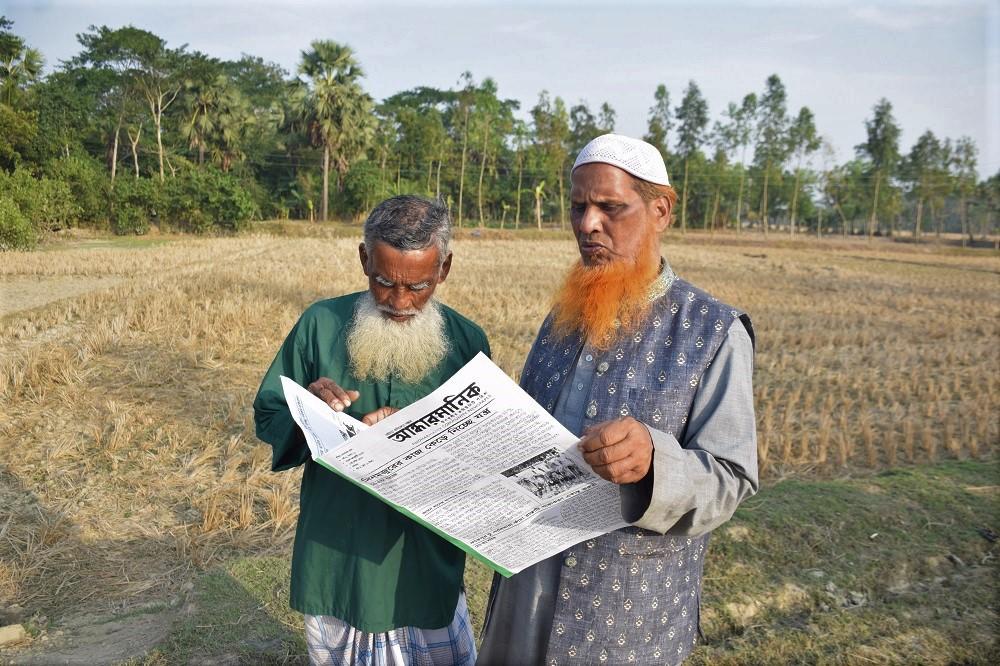
two farmers in a field reading Andharmanic
‘Andharmanik’ is a handwritten community newspaper published in Bengali from the remote village of West Sonatala in Bangladesh. Photo by Rafiqul Islam Montu.

A return to farming

‘I got the opportunity to return to farming, my old profession. But due to lack of irrigation water and salinity in the soil, I went to the city to work for a living. The fresh water stored in the village canals helped me return to farming,’ explains fifty-year-old farmer Yakub Ali.

Many like Yakub Ali now see their future in agriculture again, thanks to Andharmanik. This newspaper, which is handwritten, edited, and produced in the local community, is working to revive agriculture in the remote villages of Kalapara and to create awareness among local people to adapt and solve problems. Yakub’s home is in Paschim Sonatala village in Kalapara Upazila (sub-district) of Patuakhali. He cultivates other people’s land on a shared basis and most of the food for his family of five comes from the paddy. He has been working this profession since he was a child, following in his father’s footsteps. However, crises related to climate change had taken Yakub away from farming.

Cultivable land had shrunk due to severe salinity in the soil and water, forcing farmers to make a living in other professions. Many went to the capital Dhaka, 300 kilometers away, or the tourist center Kuakata, thirty kilometers away, to earn a living. Patuakhali District Meteorological Department sources said that the average temperature in this district has increased by 4.5 degrees Celsius in the last six years and there has also been a change in rainfall. According to the Global Climate Change Risk Index 2021, Bangladesh is the 7th most vulnerable country in the world in terms of climate risk. A World Bank report says that if necessary measures are not taken to prevent climate change, 216 million people will be internally displaced in six regions of the world by 2050, including 19.9 million people in Bangladesh. There has been an increasing global emphasis on Locally Led Adaptation (LLA) to address such risks. Andharmanik, named after a famous river in the area, is setting a powerful example by solving local problems and helping to increase agricultural production in the region by disseminating information about the problem and galvanising the community.

Local farmers explain that a canal was dug by the government five years ago to irrigate the agricultural fields between the West Sonatala and Adampur villages. But due to the lack of a dam in the canal, fresh water could not be stored. As a result, the canal was of no use to farmers. Reporters from Andharmanik listened to the community and assessed their needs to find out what could be done to solve the problem.

The villagers demanded a dam in the canal to store fresh water. A story was published in Andharmanik and this helped form public opinion. The villagers then collected money together and dammed the canal. Together, their efforts drew the attention of the government, who provided some assistance. More than 500 farmers from villages like West Sonatala, Adampur, Fatehpur, Makimpur and Pakhimara are now able to cultivate their land by storing fresh water in reservoirs including canals and ponds, and irrigating as needed.

Andharmanik — light in remote villages

Andharmanik is published in Bengali on a monthly basis from the coastal village of Paschim Sonatala, in the Nilganj Union of Kalapara Upazila. It takes about seven hours from the village to reach Dhaka by road. It is not very far from the upazila headquarters yet the people of Paschim Sonatala village were neglected for ages, with no initiatives to solve their problems. Journalists never came to the village and slow internet meant it was also difficult to read news online.

Andharmanik has taken various steps to combat the effects of climate change and improve life for people in the village. Andharmanik holds meetings with the citizens of the community on issues such as drinking water shortage, insects in crops, loss of navigability of the river, and alternative livelihoods. It then plans and publishes those stories, informing the local administration about the problems and solving some problems through the collective efforts of the local residents.

It was Hasan Parvez, a working-class youth from the village, who took the initiative to publish a handwritten newspaper to spread light in the neglected village. In an attempt to escape poverty, Hasan used to work as a laborer to support his family. Despite crises in his life, Hasan wanted to support the community.

Today the newspaper has 12 community reporters. All of them, including the editor, are workers, farmers, housewives, small businessmen, fishermen, or students of the village. The reporters travel around the village to collect information and create news. Hasan puts this information together to finish the handwritten community newspaper, which reaches readers through photocopying.

Solution Sluice Gate

The newspaper has been greeted with enthusiasm by residents who have never seen an initiative like this before. ‘Andharmanik is our newspaper,’ explains Hiron Dakua, a resident of Nijkata village. ‘We speak and it is published in this newspaper. At one time, no one looked after us. There are many crises in our villages. Due to climate change, we are facing new problems. But we had no means to overcome the crises. Andharmanik is our voice.’

Andharmanik has prompted the construction of a new sluice gate at Nizkata village, which is connected to the Nizkata canal. The previous one was destroyed long ago, making the road  dangerous; the village would be flooded when the tidal water overflowed the road. Despite many attempts by the locals, the problem could not be brought to the attention of the authorities. When villagers raised this with the newspaper, Andharmanik worked on this issue and published a series of stories that then spread via social media.

District and upazila level journalists then also wrote stories about the issue, leading authorities to take notice, after which the government allocated money for the construction of the sluice gate. The repaired sluice gate will protect the local population from climate-related environmental disasters. Villagers will be able to enter and remove water from the sluice gate as per their needs.

‘We tell our stories. Through these stories, information from remote villages is spread everywhere. This is how crises are resolved. Our voices bring solutions for us,’ adds Manoranjan Khayrati, who also lives in Nijkata village.

From the dam to the sluice gate, to other climate-related solutions, including winning governmental and organisational housing and educational support for the families of fishermen who have lost their lives in Bangladesh's increasingly rough seas, Andharmanik is a powerful example of community-led adaptation that could be repeated elsewhere.

‘Through this newspaper, we want to build bridges between the people of the village,’ founder and editor Hasan Parvez, explains. ‘We want to solve local problems. We want to change the perspective of the people. We want a change in society. We are already seeing the change.’

1.

15-20 years ago, rainfall would start from April and continue for about six months. Reduced rainfall has impacted agricultural diversity. Patuakhali Agricultural Extension Department sources said that the negative impact of the climate crisis is being felt the most in the agricultural sector.

2.

David Eckstein, Vera Künzel, and Laura Schäfer, Global Climate Risk Index 2021, (2021).

3.

World Bank Group, Climate Change Could Force 216 Million People to Migrate Within Their Own Countries by 2050, (2021). 40 million people will be displaced in the South Asia region. The ‘Global Report on Internal Displacement 2021’ report by the Internal Displacement Monitoring Center (IDMC) says that 4.443 million people were displaced in Bangladesh in 2020.

More Reads